DJIBOUTI / YEMEN: Escalating fighting in Yemen has forced thousands of civilians to flee their homes and cross the Red Sea to neighbouring Djibouti, leaving behind their belongings, livelihoods and familiar surroundings in a desperate search for safety. With airstrikes, gunfire and advancing Houthi fighters intensifying the conflict, families are facing growing uncertainty about their future.
Among those displaced is 50-year-old Abubaker Saeed, who was fishing in the Red Sea off Yemen’s coast when he noticed explosions in the distance last month. Worried about his wife and two young children, aged nine months and five years, he immediately rushed back to his village of al-Wahijah.
Aircraft belonging to the Saudi-led coalition, which supports Yemen’s internationally recognised government, were carrying out airstrikes against Iran-aligned Houthi fighters advancing towards the nearby port city of Mocha.
Saeed recalled that the bombing was taking place close to his village, while Houthi fighters were only about a kilometre away. As he attempted to reach his home, he witnessed three people being shot dead during the fighting.
Despite the chaos caused by explosions and gunfire, Saeed managed to reunite with his family. They remained inside their house for nearly 12 hours as the clashes continued, until government forces withdrew from the area.
Realising that his family could no longer remain safely in the village, Saeed decided to flee. With Houthi fighters controlling the overland routes to safer areas, he had little choice but to attempt a dangerous sea crossing to Djibouti.
The family walked to the nearby shore with nothing but the clothes they were wearing. They boarded a boat carrying around 80 other people. Although the operators charged approximately 100,000 Yemeni rials, equivalent to about £320, per family, they allowed Saeed’s family to travel without payment.
After a nine-hour journey, they reached Djibouti, where they are now sheltering at the overcrowded Markazi humanitarian site near the fishing town of Obock.
Pointing to the white T-shirt he had worn while escaping, Saeed described the painful reality of leaving his entire life behind.
“I left everything behind,” he said.
Renewed Fighting Deepens Yemen’s Humanitarian Crisis
The latest escalation has further worsened Yemen’s already severe humanitarian emergency. According to the figures cited in the report, more than 900 people have been killed and at least 250,000 displaced since the beginning of August.
The United Nations estimates that more than half of Yemen’s population requires humanitarian assistance, following more than a decade of conflict, economic hardship and instability.
Aid organisations warn that continuing clashes, insecurity and restrictions on movement are making it increasingly difficult to reach displaced families and provide essential supplies.
Laila Al Amine, regional programmes director at Prosper Global, formerly Mercy Corps, said the situation was becoming more challenging as people continued to flee violence.
She said more than 100,000 people had sought refuge in Taiz governorate, where humanitarian agencies are assisting displaced communities.
After years of conflict, she warned, families should not have to repeatedly abandon their homes in search of safety.
Taiz and the Red Sea Coast Become Major Conflict Zones
Taiz, Yemen’s third-largest city, and the southwestern Red Sea coast have witnessed intensified fighting as Houthi forces and government troops battle for territorial control.
The situation around Taiz has become particularly concerning, with Houthi fighters encircling the city and taking control of important routes leading in and out. The developments have raised fears that the city could face a prolonged siege, potentially restricting access to food, medical supplies and other essential services.
The conflict has also spread across areas surrounding the Bab al-Mandab Strait, a strategically important maritime passage connecting the Red Sea with the Gulf of Aden. The waterway lies between Yemen and the African countries of Djibouti and Eritrea and is a vital route for international trade and shipping.
The renewed fighting in the region has heightened concerns about the wider economic and security consequences of the conflict.
Families Escape Airstrikes and Forced Recruitment
Among the displaced people living at the Markazi site is 43-year-old Madinah Abdullah, who fled Mocha with her family after surviving airstrikes and gunfire.
Abdullah said her family had been living on the front line as the fighting intensified. They eventually escaped after Houthi fighters took control of the area following the withdrawal of government forces.
She also expressed concern about reports of boys and young men being forcibly recruited by Houthi fighters or accused of supporting government forces.
Her greatest fear was that the fighters might target her 16-year-old son.
Abdullah and eight other members of her family hid until they found an opportunity to escape. They then boarded a fishing boat with approximately 40 other people and crossed to Djibouti.
Recalling life before the latest escalation, she said Mocha had once been a peaceful place to live, but the conflict had disrupted everything.
The Markazi site was already accommodating refugees, including Yemenis who had fled earlier stages of the civil war that began in 2014. The arrival of new families has placed additional pressure on facilities that were already stretched.
Djibouti Struggles to Meet Growing Needs
According to Yemen’s office for assistance to refugees and disaster victims, the number of newly arrived Yemenis in Djibouti had reached 3,807 by October 8.
Mahdi Osman, a coordinator at the agency, said the rapid increase in arrivals was placing growing pressure on shelter, drinking water, sanitation, food distribution and healthcare services.
He warned that the biggest challenge was the widening gap between the number of people arriving and the resources available to meet their essential needs.
Although Djibouti continues to provide refuge to people escaping violence, its limited resources make international assistance increasingly important.
Humanitarian officials have called on the international community to support the Djiboutian government and ensure that new arrivals receive adequate protection, shelter and essential services.
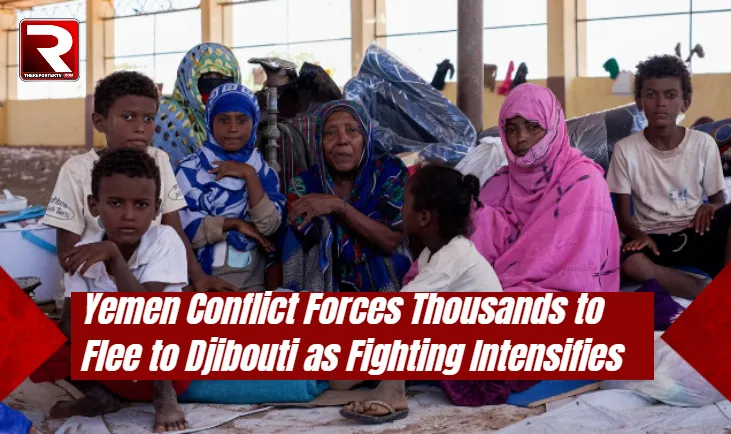
At the Markazi site, families can be seen sitting beside their remaining possessions, including mattresses, plastic containers and buckets. Children play nearby while women gather in small groups, trying to maintain a sense of normal life despite the uncertainty surrounding them.
The immediate needs are basic but urgent: sufficient food, safe drinking water, adequate shelter and access to medical care.
A Conflict With Regional Implications
Yemen’s civil war began in 2014 when Houthi forces took control of the capital, Sana’a, and challenged the internationally recognised government. A military coalition led by Saudi Arabia, with the United Arab Emirates among its participants, intervened the following year to support the government.
A United Nations-brokered truce was established in 2022 and was largely observed for an extended period. However, renewed hostilities and attacks involving the Houthis and regional actors have contributed to a fresh escalation.
The strategic importance of the Bab al-Mandab Strait has added another dimension to the conflict. Disruptions to other major maritime routes have increased attention on alternative shipping corridors, while attacks on airports, oil facilities and tankers have raised fears of a broader regional confrontation.
The reported missile attack on King Khalid International Airport in Riyadh on October 10, which the supplied report says killed 13 people, has further intensified concerns about the potential expansion of the conflict.
Security experts fear that continued escalation could draw additional countries into the crisis, making a peaceful resolution more difficult.
Displaced Families Hope to Return Home
For many Yemenis who have reached Djibouti, displacement is not a new experience. Some have already endured years of insecurity, lost livelihoods and separation from their communities.
Aisha Ismail, 33, fled Yemen in September with her sister and their 85-year-old father, who has a hearing impairment. She still carries a bullet in her leg from a shooting during the early stages of the civil war.
The family escaped from Dhubab, a town north of the Bab al-Mandab Strait. They travelled several miles in search of a boat and eventually crossed to Djibouti with more than 100 other people.
Ismail previously sold potatoes to support herself, her sister and her elderly father. Although food is distributed at the humanitarian site, she said the supplies were insufficient to meet the family’s needs.
She described fleeing in fear, with no time to collect their belongings.
The shortage of food and other necessities has made an already difficult situation even more distressing for vulnerable families.
Meanwhile, Saeed has begun volunteering at a water collection point in the camp, helping children and other vulnerable people access drinking water in an orderly manner.
Despite losing his home and livelihood, he continues to hope that the conflict will end and his family will one day be able to return to Yemen.
His wish reflects the hopes of thousands of displaced Yemenis who are struggling to rebuild their lives far from home.
For these families, reaching Djibouti has offered temporary refuge, but their future remains uncertain. Without an end to the fighting and sustained humanitarian assistance, the crisis is likely to deepen, leaving more civilians exposed to hunger, displacement and prolonged hardship.
For now, their greatest hope is simple: an end to the violence, a safe return home and the chance to live in peace.