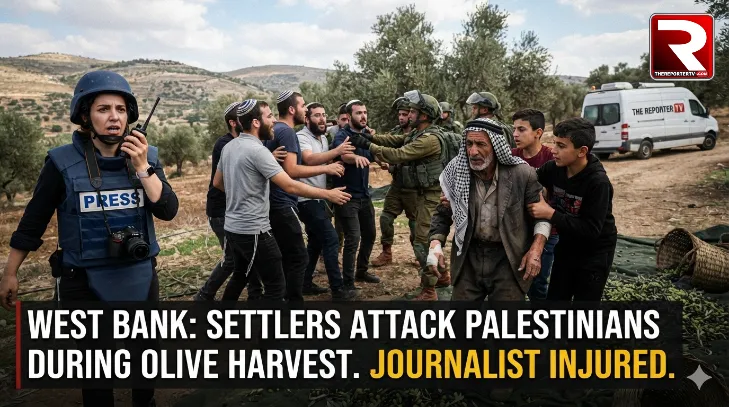
Delhi – Ramallah: Israeli settlers have carried out a series of attacks against Palestinians across the occupied West Bank, disrupting the annual olive harvest, setting vehicles and olive trees on fire, and injuring several people, including a Washington Post photographer.
The attacks took place on Friday, when masked settlers armed with clubs and other weapons targeted Palestinian farmers attempting to harvest olives in several towns across the West Bank.
According to the Palestinian Red Crescent Society, at least six people were injured in Abu Falah, near Ramallah, during one of the attacks.
Armed Settlers Target Palestinian Farmers
Witnesses reported that at least 80 Israeli settlers gathered in Abu Falah to prevent Palestinians from harvesting their olives. Some of the attackers were reportedly carrying firearms and clubs, while others used slingshots to hurl stones at farmers.
The incident unfolded in the presence of Israeli military vehicles. When some Palestinians picked up stones in an attempt to defend themselves, Israeli forces reportedly fired tear gas in their direction.
The violence has raised renewed concerns over the safety of Palestinian farmers during one of the most important agricultural seasons in the region.
Washington Post Photographer Assaulted
Among those injured was Heidi Levine, a photographer working for The Washington Post. According to witnesses, she was assaulted by settlers for more than 10 minutes and was repeatedly kicked after being pushed to the ground.
Levine was wearing a protective flak jacket and helmet when the attack occurred. She also reported that the attackers stole her passport, mobile phone, wallet and professional equipment.
Speaking from a hospital bed in Ramallah, Levine said she feared for her life during the assault. She credited her Palestinian colleagues with intervening and helping bring the attack to an end.
The Washington Post stated that Levine had been wearing clearly visible markings identifying her as a journalist.
The Israeli Foreign Press Association condemned the incident, describing it as part of a continuing pattern of violence against journalists and civilians in the occupied West Bank. The association said repeated calls for Israeli authorities to take action against such attacks had gone unanswered.
Sharp Increase in Settler Violence
According to Israeli human rights organisation Yesh Din, Israeli settlers have carried out at least 170 attacks since September 27, coinciding with the beginning of the annual olive harvest.
Palestinian authorities reported that at least four Palestinians had been killed and more than 100 injured over the preceding month. Thousands of olive trees have also reportedly been damaged.
Although attacks against Palestinian farmers during the olive harvest have occurred for years, rights groups say the scale of violence has increased this season, amid Israel’s approaching elections at the end of October.
New Restrictions on Olive Harvesting
The violence has been compounded by new Israeli military restrictions affecting Palestinian farmers in Area C, which remains under Israeli military control and contains much of the West Bank’s agricultural land.
Under the new rules, Palestinians are prohibited from accessing approximately 8,800 hectares (21,800 acres) of agricultural land without military approval. This represents a reported 30 per cent increase compared with the previous year.
Meanwhile, the Israeli rights group Peace Now says the area from which Israeli citizens were barred from entering decreased from approximately 1,070 hectares in 2025 to 680 hectares in 2026, under measures intended to prevent settler violence.
The restrictions have raised concerns about unequal access to agricultural land and the ability of Palestinian families to earn a livelihood from their olive groves.
Olive Harvest a Vital Source of Income
The annual olive harvest is a crucial economic lifeline for thousands of Palestinian families. Its importance has grown since Israel revoked work permits for many Palestinians in the West Bank following the Hamas-led attack on October 7, 2023.
Photographs and videos from Kufur Malek, near Ramallah, have shown large areas of agricultural land where olive trees were reportedly uprooted by Israeli bulldozers.
In another incident near Turmus Ayya, settlers reportedly attacked Palestinians harvesting olives and set three cars on fire, just hours before the assault in Abu Falah.
Videos shared by Israeli human rights organisation B’Tselem also showed hundreds of bags of olives that the group said had been forcibly taken from Palestinian farmers and transported to Israeli olive presses.
Independent activist Sarit Michaeli said the scale of olive theft was unprecedented in her more than 22 years of work on the issue.
Limited Accountability and International Concerns
Human rights organisations have repeatedly criticised what they describe as the lack of accountability for settler violence in the West Bank. Activists allege that Israeli military forces often fail to prevent attacks and sometimes intervene against Palestinians who attempt to defend themselves.
Israeli Prime Minister Benjamin Netanyahu has occasionally condemned settler violence, attributing it to a small group of approximately 100 settlers. However, critics argue that stronger measures are needed to prevent further attacks.
The expansion of Israeli settlements across the occupied West Bank under Netanyahu’s right-wing government has also drawn widespread international condemnation. The United Nations and most countries consider Israeli settlements in the occupied territory to be contrary to international law.
Following the attack in Abu Falah, a spokesperson for the US Embassy in Jerusalem confirmed awareness of reports about the incident but declined to comment further, citing privacy laws.
As the olive harvest continues, Palestinian farmers and press freedom advocates are calling for greater protection for civilians and journalists, as well as effective action to prevent further violence and safeguard Palestinian livelihoods.