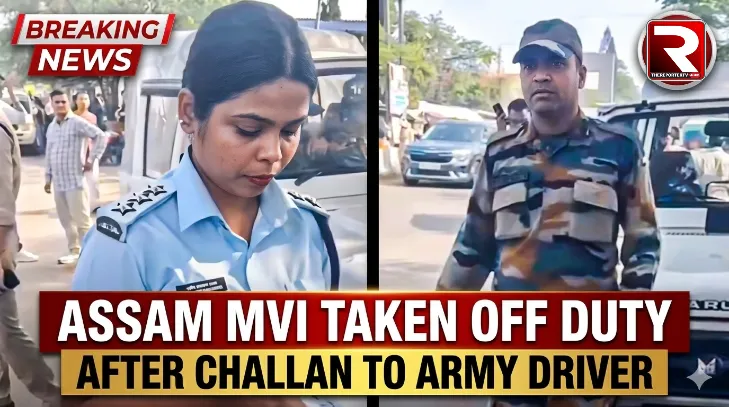
Jorhat, Assam: An incident involving a Motor Vehicle Inspector (MVI) and an Indian Army driver in Assam’s Jorhat district has triggered widespread discussion over the balance between strict traffic enforcement and sensitivity toward defence personnel on official duty.
The controversy began during a routine road safety enforcement drive on November 19 near the Inter-State Bus Terminal (ISBT) on the busy AT Road in Jorhat. Motor Vehicle Inspector Samim Sultana stopped an official Army vehicle belonging to the 41 Sub-Area of the Jorhat Military Station at Lichubari and issued a challan after the driver was found not wearing a seat belt while performing official duties.
As videos of the exchange spread rapidly across social media, speculation grew that the Army driver had been penalized for not carrying a valid civilian driving licence. However, district transport authorities later clarified that this claim was incorrect.
Jorhat District Transport Officer Dhananjoy Saikia stated that the challan was issued solely for the seat belt violation. He explained that Army personnel are legally permitted to operate military vehicles using an Army-issued driving licence and are not required to possess a civilian licence for such official duties.
While defending the enforcement action itself, Saikia acknowledged that the MVI’s manner of questioning the Army driver could have been more courteous. As a result, Samim Sultana has been taken off duty for a day or two while the matter is reviewed.
The Jorhat district administration also issued an official statement explaining that the enforcement drive was part of a statewide road safety campaign launched after the tragic November 13 road accident in neighbouring Golaghat district, where 26 people lost their lives. Authorities had instructed transport officials across Assam to intensify traffic enforcement to improve road safety.
The administration admitted that the incident involving the Defence vehicle had created an uncomfortable situation and expressed regret for any unintended embarrassment or inconvenience caused to Army personnel. Officials emphasized that there was never any intention to disrespect the armed forces or hurt their sentiments.
Following the incident, a joint meeting was held between civil authorities and senior Army officials, including the General Officer Commanding of Headquarters 41 Sub-Area, Lichubari. The discussions focused on addressing misunderstandings and reinforcing coordination between the Defence establishment and the civil administration.
Officials agreed that misinformation surrounding the incident had contributed to public confusion and stressed the importance of maintaining mutual trust and cooperation between the two institutions.
To prevent similar situations in the future, the district administration has instructed enforcement personnel to exercise greater sensitivity, discretion and caution while dealing with vehicles belonging to the armed forces, emergency services and ambulances, considering the unique responsibilities and operational requirements associated with these services.
Reaffirming its respect for the military, the administration concluded that the armed forces continue to enjoy the highest regard for their service to the nation and that efforts would be made to ensure effective law enforcement without compromising institutional respect or coordination.